
How will AI change ERPs, as we know them today? I spoke about this earlier in a webinar, and it’s a big topic. But here is a short summary of some key takeaways.
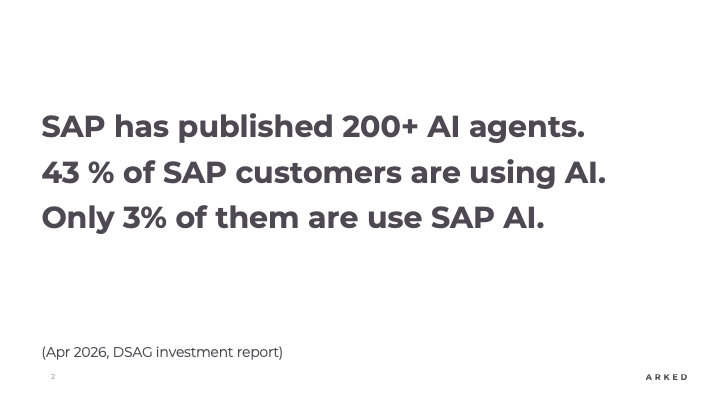
First, let’s start with one interesting number. SAP is one of the biggest ERPs out there. SAP has published over 200 AI agents. According to the DSAG investment report 2026, 43% of SAP customers are using AI. But of those customers, only 3% are using SAP AI. So it seems AI usage is happening somewhere outside the ERPs.
What an ERP is and why do we need one?
Before we start planning technology, AI or anything else, it’s good to understand what problem we are actually solving. In the case of ERPs, what’s the problem behind the need to have an ERP?
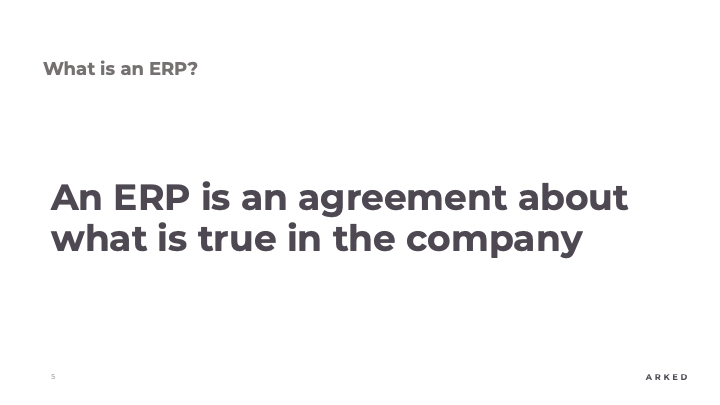
At the core, an ERP is an agreement about what is true in a company.
In big organisations we can’t have a situation where sales has its numbers, finance has other numbers, and operations a third set of numbers. All are different, and everybody argues whose Excel is right. An ERP is a set of data and rules on how to create information that everybody agrees on, that has a clear audit trail and accountability, and that can be shared as common truth in the organisation.
If we need to know whether a customer made an order or not, we can find the info in the same place. We know when the order shipped. When the tax audit comes, we have a shared truth that tells who ordered what, when it was invoiced and when it was paid.
So how does AI change all this?
Three scenarios how AI changes ERPs
Scenario 1: No big changes, using ERPs just gets easier
The first scenario is that ERPs stay mostly as they are today, but AI just makes using them easier. Instead of navigating through complex menus and options, you can just use natural language with an AI chatbot and ask it to create the reports you need, or update the information you want updated. This is already happening today.
Scenario 2: The interface stops being the product
The second scenario is that the role of the ERP changes from the current user interface most people see and use, to just data storage and processing rules. Users no longer log in to the ERP and use the ERP’s user interface for reporting, data entry etc. Instead, there will be various AI interfaces that different companies use and build. You can use the ERP through your Claude Desktop client, or your company can develop its own custom UI using AI that fits exactly that company’s processes and practices. There won’t be one single UI for the ERP, but countless AI-based applications. This will also change business models: no more per-seat licensing.
Scenario 3: No single system of record, AI creates the answer
Imagine an AI that is clearly more powerful than today’s best models, and that has access to all your company’s data in real time: emails, documents, Slack discussions, meeting notes etc. Why do we anymore need to copy all that data to a single ERP system? If you want to know whether a customer made an order, you can find the signed order from an email. If you want to know whether the customer paid for the order, you can find that info from bank account data. If you want to forecast future sales, you can just check sales people’s calendars, emails and meeting notes. There is no more need to consolidate all this data into one format in one system that we today call an ERP.
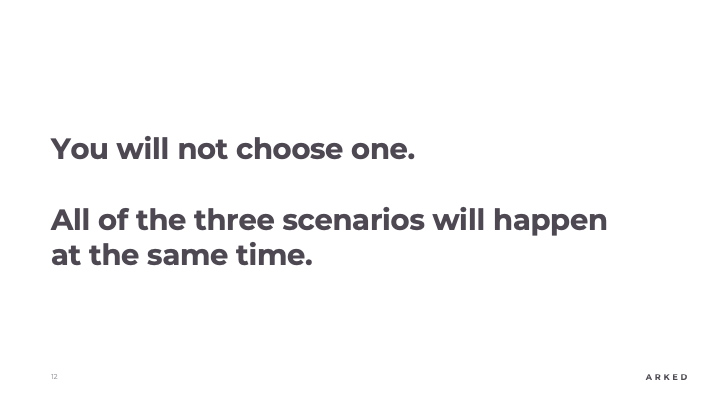
You won’t choose one scenario
All of the three scenarios are already happening today, and in the future they will be used one way or another. AI already makes using ERPs easier today. Companies are already integrating their own AIs and UIs into ERPs using different APIs. And AIs are already gathering data automatically from various sources.
If you are planning to purchase or build an ERP today, scenario 1 is a baseline. It must be there today. Scenario 2 is something you should build your architecture on. And you should be ready for scenario 3, if it arrives sooner than you think. But note that different auditors and authorities are not ready for that for a while.
What to do right now
If you are starting an ERP project in 2026, focus on a few key things.
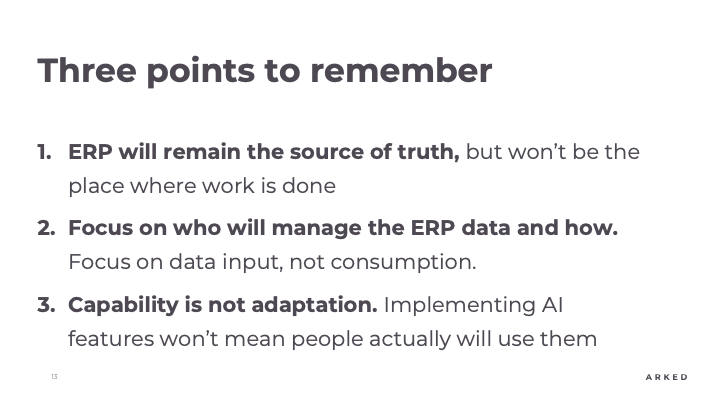
Check that you, as a customer, have full and unlimited access to the raw data in the ERP. Make sure that the ERP vendor doesn’t hold your data hostage. A few traditional APIs are not enough. You need to be able to get all your data out easily, and stream it in real time to another system if you want.
Put data and API access into the contract. We have seen cases in the industry where you just approve general terms & conditions for API access. And those can change, for example to prevent you from using AI systems to interact with the ERP.
Focus on data input, not on how data is consumed. Most ERP projects start by planning data consumption: what kind of reports we want, what data we want to see, how we want to slice and dice the data and so on. But these are the things you can easily change later with AI. However, AI is fully dependent on data quality. If data input is too difficult for users, takes too much time, or managing data quality is too hard, then AI won’t work. Don’t focus on who uses the data, focus on who enters the data into the system.
Build governance before you scale. A lot of companies build AI capabilities fast without thinking about how to govern them later. This creates big problems after the initial demo or proof-of-concept is done, and in the end many companies end up decommissioning already implemented AI solutions and wasting money. For example, Gartner forecasts that 40% of companies, who have built AI solutions, will start decommissioning some of them in 2027.
How Arked can help
If you need help in planning or implementing your ERP projects, here is what we at Arked can do:
- AI product strategy: we help you plan where AI should be used, and also where it should not be, so that you can focus on the main business benefits.
- Procurement consulting: if you are planning a tender for a new ERP, we can help you with what to consider to ensure AI capabilities in the future.
- AI governance, risk management and compliance: we can help you plan governance practices that enable AI use, rather than kill it with heavy bureaucracy.
- Daily AI operations: if you are already building AI agents and using other AI tools, we can build daily practices on how to monitor them and manage costs, quality and security.
